





Long Videos Fail Between Shots, Not Inside One Shot
A good operating model keeps every handoff explicit. The first impressive clip can be misleading because how to prompt motion, lighting, timing, and scene flow so separate generations can edit together. Teams need a process that can be repeated under deadlines, brand rules, and changing formats. AI Video Creation work on Xelta becomes more useful when the brief, review criteria, and final destination are defined before anyone generates footage.
For filmmakers, long-form creators, educators, and branded content teams, the practical goal is not to remove human judgment. It is to convert a narrative beat sheet, continuity references, shot contracts, timing plan, and audio map into a coherent long video built from reviewed scenes rather than one uncontrolled generation. That requires clear acceptance criteria, organized source assets, and a review record. The workflow below focuses on continuity, shot design, pacing, lighting logic, and sequence assembly. It avoids unsupported performance promises and treats every generated clip as production material that still needs human approval.
The Sequence-First Answer
A useful ai video generator for long videos should follow a detailed brief, produce controllable drafts, support clear revision, and fit the team's publishing process. Evaluate it with real source assets and a channel-specific task, then measure factual accuracy, continuity, editability, and review effort. A ai video generator for long videos is valuable when it shortens the path to an approved asset, not only the first generation.
Think in Editable Scenes Instead of One Long Prompt
A useful decision model separates outcome, control, and risk. Outcome asks whether the viewer receives the intended message. Control asks whether feedback changes the correct element. Risk asks whether facts, rights, identity, or placement can create a publishing problem. These three lenses keep connected long-form sequences assembled from controlled shots from being approved on visual taste alone.
A Continuity System for Motion, Light, and Time
Use a simple operating model with five layers. The source layer contains approved facts, product details, references, and exclusions. The brief layer converts those materials into a scene or asset specification. The generation layer produces options in small reviewable units. The editorial layer selects, edits, captions, and checks continuity. The release layer confirms format, destination, ownership, and final approval.
The layers matter because a problem should be fixed where it began. Incorrect product information is a source problem. A confusing camera move is a brief or generation problem. Weak pacing is often an editorial problem. A mismatched CTA is a release problem. This diagnosis reduces random prompt rewriting and protects the team from repeating the same defect across many versions.

Write the Beat Before the Camera Instruction
Describe the story action in plain language before adding lenses, movement, atmosphere, or style. Each beat should state what changes for the viewer. A camera move is useful only when it supports that change. Story beats prevent technically attractive but narratively empty shots. Input: Outline, audience goal, and target duration. Output: A beat sheet with one outcome per scene. Review: Remove scenes that repeat the same information. Next: Turn each beat into a shot contract.
Lock Visual References and Direction of Movement
Create reference frames for people, wardrobe, products, locations, time of day, and color. Record screen direction, entry and exit points, and the position of key objects. These details help separate generations cut together. Continuity depends on repeated visual facts. Input: Reference images, character notes, and location plan. Output: A continuity board. Review: Check left-right movement and object placement. Next: Attach the relevant references to each shot.
Prompt Duration and Action With Edit Points
State the action start, middle, and finish, then identify a clean opening or ending frame for the edit. Avoid packing several unrelated actions into one short generation. Give timing cues such as slow reveal, brief pause, or steady five-second movement only when they serve the cut. Edit points make generated shots usable. Input: Shot contract and timeline target. Output: A timing-aware prompt and expected cut point. Review: Review whether action completes inside the shot. Next: Generate alternates for critical transitions.
Design Lighting Changes That Motivate the Story
Keep light direction and intensity consistent inside a scene. Change lighting only when time, location, mood, or story state changes. Record the motivation in the scene plan so a bright close-up does not follow a dark wide shot without explanation. Lighting continuity carries time and emotion. Input: Reference frame, scene order, and mood plan. Output: A lighting map across the sequence. Review: Compare adjacent shots side by side. Next: Revise the outlier, not the whole sequence.

Assemble, Watch, and Repair the Sequence
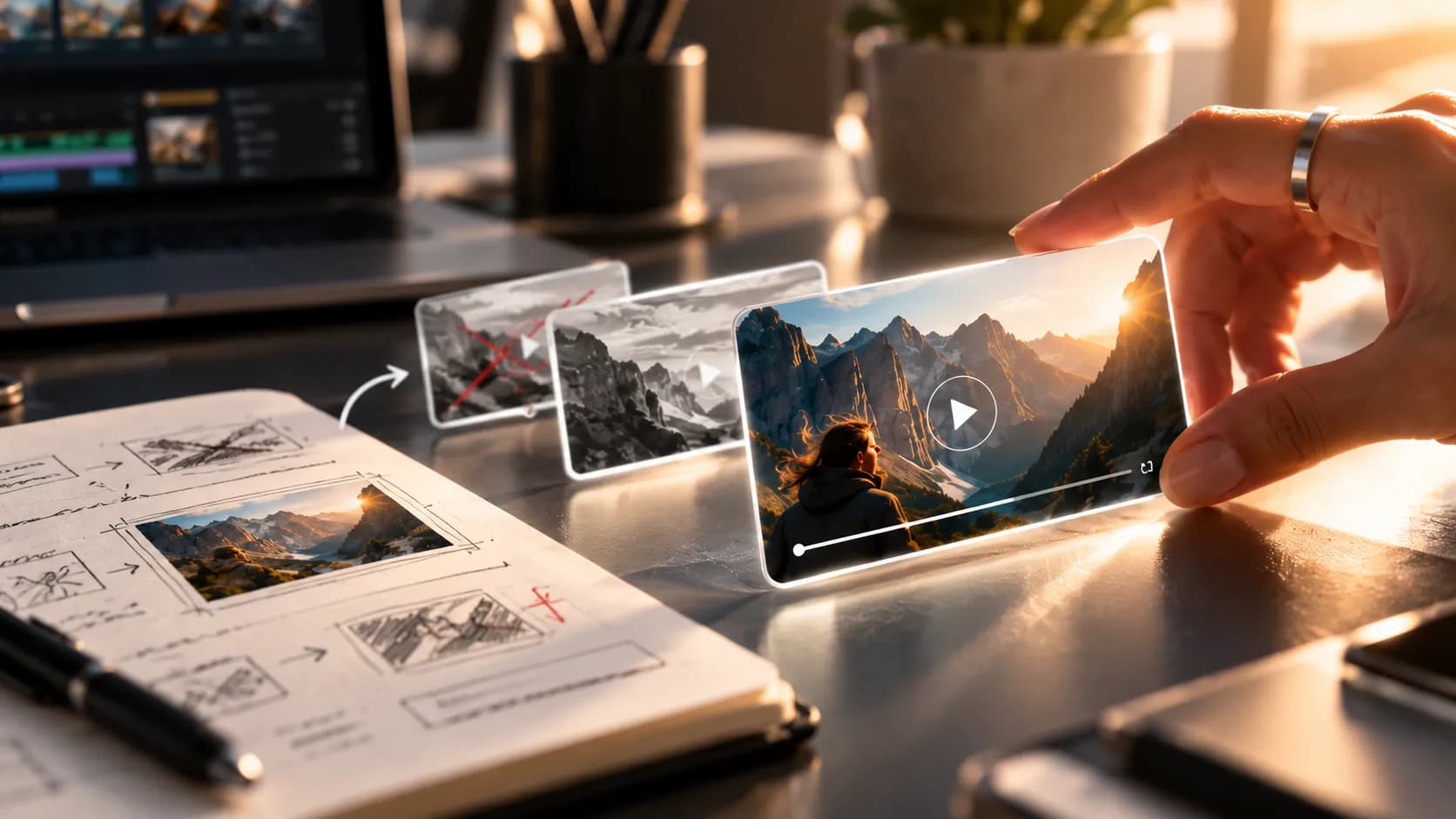
Edit an early rough cut with temporary audio. Watch once for story, once for continuity, and once for rhythm. Replace the smallest failing unit instead of regenerating everything. Use cutaways, reaction shots, or environmental inserts to bridge necessary changes. Sequence review reveals problems no single clip shows. Input: Selected shots, audio map, and timeline. Output: A repair list tied to timestamps. Review: Prioritize narrative breaks before cosmetic defects. Next: Generate only the missing bridge or replacement shot.
An Eight-Minute Founder Story Broken Into Beats
A useful worked scenario is an eight-minute founder story built from interview-led narration, product scenes, environment shots, and controlled transitions. The team starts by identifying the single message and the evidence that supports it. It then creates a small set of related drafts, reviews them against the same checklist, and records which scenes can be reused. The point of the example is not a claimed result. It shows how one controlled source pack can support several deliverables while keeping the message recognizable.
The team should still reject any output that changes a product fact, creates a misleading visual, or requires more repair than a simpler production method. A worked scenario is valuable only when it makes the inputs, review steps, and limitations clear.
Single Generation, Scene Chain, and Hybrid Production
The approaches below are not universal winners. They differ in coordination, control, speed of variation, and review burden. Choose the method that fits the importance of the asset, the available source material, the team's editing skill, and the cost of an error. For connected long-form sequences assembled from controlled shots, the best option is the one that reaches approval predictably.
Continuity Breaks That Damage Long-Form Work
Common failure patterns include asking one prompt to handle an entire chapter, changing lighting style without a story reason, ignoring screen direction between adjacent shots, writing movement without a clear action endpoint, and waiting until the final edit to test scene rhythm. Each one hides the real cost of the workflow. A team should label the defect, identify its source layer, and decide whether to revise, replace, or stop. Vague feedback creates more versions without creating more certainty.

Practices That Make Shots Easier to Join
Useful operating habits are to maintain a continuity board beside the timeline, use one dominant action per generated shot, plan cut points in the prompt, compare adjacent frames before approving a scene, and repair the smallest broken unit instead of restarting. These practices create a shared language between strategy, creative, product, legal, and publishing reviewers. They also make it easier to compare future projects because the team keeps the brief, accepted output, rejected output, and reason for each decision.
Where Cinematic Studio Supports Connected Scenes
Xelta can enter after the team has a defined brief and source pack. The core generator can be used to explore the visual direction, while Xelta Cinematic Studio for planning connected multi-scene sequences provides a more specific next step for this topic. The user still needs to choose references, write instructions, review the draft, and decide whether the output is accurate enough for the intended use.
The practical value is reduced handoff friction between idea, draft, and variation. It should not be described as automatic approval. Brand, factual, rights, accessibility, and placement checks remain human responsibilities.
What Iteration Feels Like on a Longer Timeline
The ideal user arrives with a narrative beat sheet, continuity references, shot contracts, timing plan, and audio map. The first action is to turn that material into a narrow generation task. The first draft is a direction check, not the final asset. During iteration, the user changes one important variable at a time and keeps accepted elements fixed. Xelta video workflow examples can be used as an additional learning destination without replacing project-specific review.
The workflow advantage is faster exploration and easier creation of related versions. The learning curve comes from writing precise briefs, selecting references, and recognizing defects. Limitations include inconsistent details, continuity breaks, or outputs that need editing. The final use should always be tied to a named approved version and destination.
Describe Sequences So Search Systems Can Understand Them
For search and generative retrieval, explain the entities, inputs, outputs, decisions, and limits in direct language. Place a concise answer near the top, use headings that match real tasks, and keep examples clearly labeled. Do not mix product facts with recommendations. When a time-sensitive feature, policy, price, or technical limit is mentioned, it should be verified and sourced before publication.
This guidance is written for filmmakers, long-form creators, educators, and branded content teams and is based on practical content operations: controlled briefs, staged production, and human review. It does not promise rankings, citations, or business results. The method is useful because another reviewer can follow the same steps and understand why an asset was accepted.

Build the Long Video One Reliable Cut at a Time
Start with one real brief, one destination, and one review checklist. Produce a small set of controlled drafts, record the defects, and keep only the workflow that can be repeated. The next practical step is to open Cinematic Studio and test the topic-specific process with approved source material.