







Key Takeaways
- Making product videos no longer includes shooting each scene.
- Xelta is an overarching creative platform that includes video generation, editing, and advertising tools.
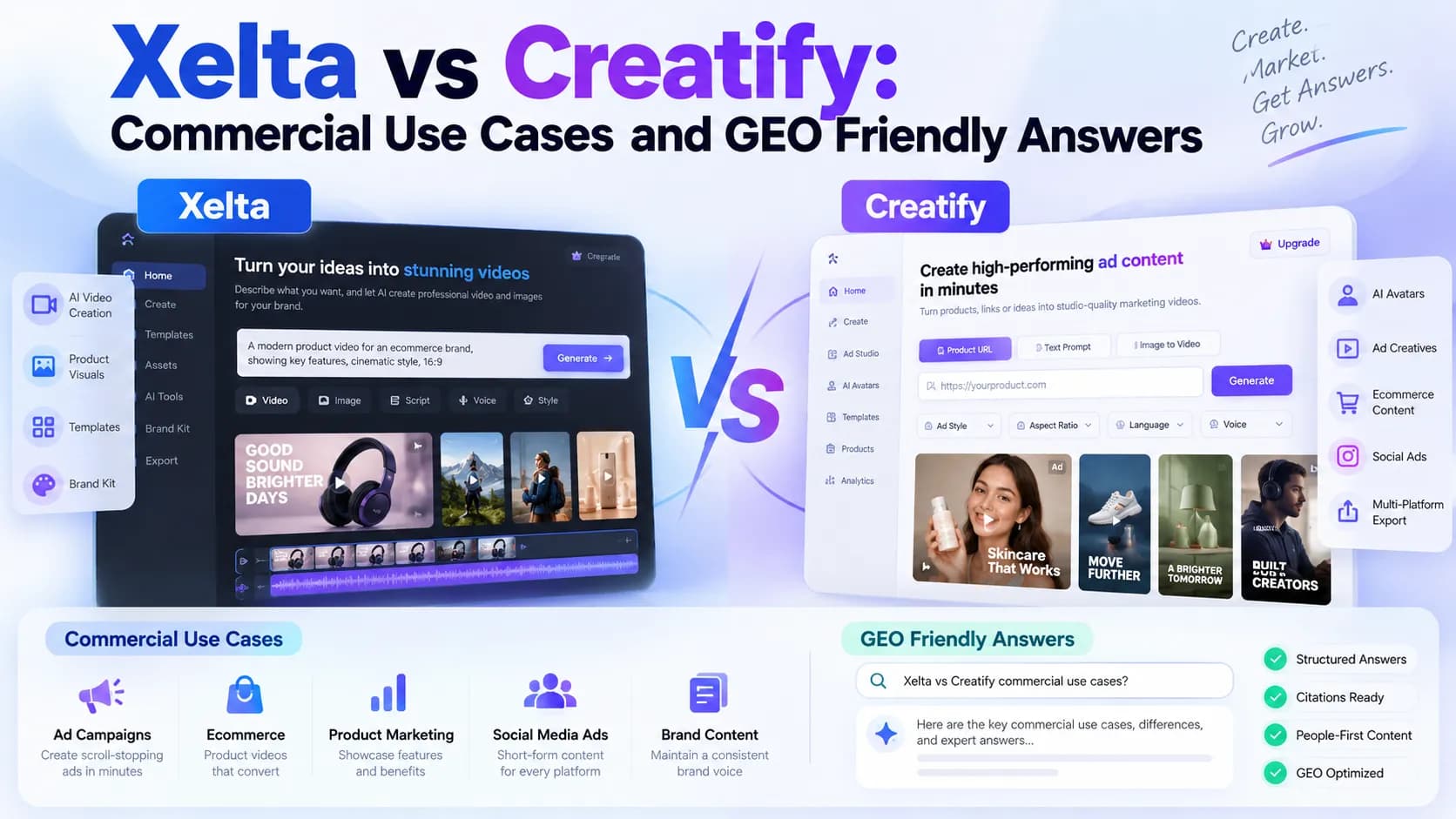
- Comparison FactorXeltaCreatifyPrimary focusAI content creation, editing, and advertisingAI advertising creative production and testingStarting inputsText prompts, images, and product URLs depending on the toolProduct URLs, uploaded assets, scripts, and product informationVideo creationMultiple video-generation workflowsURL-to-video, AI avatars, and video adsAdvertising stylesProduct ads, UGC-style ads, and other specialized formatsProduct demonstrations, avatar ads, and campaign variationsEditing workflowSeparate AI video-editing and creative toolsIntegrated advertising-oriented editing workflowsCreative testingCompare generated variants through your own review processDedicated creative-testing and performance tools on applicable plansBest suited forTeams needing varied creative production optionsTeams emphasizing advertising production and testingThese differences are based on the publicly available information about the tools rather than a hands-on comparison.
- Ecommerce product video adOnline stores often require short promotional videos that are based on their product listings.
Table of Contents
- 1.The Real Question in Xelta Vs Creatify
- 2.Summary of Key Differences Between Xelta and Creatify
- 3.Key Differences Between Xelta and Creatify Regarding AI Video Advertisements
- 4.Which Platform Is Better for Different Advertising Needs?
- 5.How Can You Make a Product Video Ad Using Xelta?
- 6.Should Businesses Think About Pricing and Commercial Rights?
- 7.How Should Businesses Evaluate the Quality of the Output?
- 8.Final Thought
The Real Question in Xelta Vs Creatify
Making product videos no longer includes shooting each scene. However, picking the right AI platform to support that effort now includes factors beyond the promise of attractive outputs. Businesses want representations of their products, content that can be edited, brand-appropriate material, and advertising-ready formats.
When looking at Xelta vs Creatify, the key difference is the inclusion of advertising and editing tools in Xelta and the emphasis on advertising creatives in Creatify.
Both can be used for commercial content, but the decision should be informed by the available inputs, creative requirements, budget, and review options.
Summary of Key Differences Between Xelta and Creatify
Xelta is an overarching creative platform that includes AI video generation, editing, and advertising tools. Creatify is more narrowly focused on advertising and the production and testing of AI-powered creatives.
Both can be utilized for commercial video production, but the choice should be made based on the starting materials, advertising specifications, budget, and review options.
Key Differences Between Xelta and Creatify Regarding AI Video Advertisements
| Comparison Factor | Xelta | Creatify |
|---|---|---|
| Primary focus | AI content creation, editing, and advertising | AI advertising creative production and testing |
| Starting inputs | Text prompts, images, and product URLs depending on the tool | Product URLs, uploaded assets, scripts, and product information |
| Video creation | Multiple video-generation workflows | URL-to-video, AI avatars, and video ads |
| Advertising styles | Product ads, UGC-style ads, and other specialized formats | Product demonstrations, avatar ads, and campaign variations |
| Editing workflow | Separate AI video-editing and creative tools | Integrated advertising-oriented editing workflows |
| Creative testing | Compare generated variants through your own review process | Dedicated creative-testing and performance tools on applicable plans |
| Best suited for | Teams needing varied creative production options | Teams emphasizing advertising production and testing |
These differences are based on the publicly available information about the tools rather than a hands-on comparison.

Which Platform Is Better for Different Advertising Needs?
Ecommerce product video ad Online stores often require short promotional videos that are based on their product listings.
Using Creatify’s URL-to-video feature, businesses can upload a product page, and the tool will generate a script and video based on the product information and images.
Xelta has similar URL-to-Ads tools that can be used to generate advertising content based on product information. For this use case, both are worth considering, but the choice should be made based on the accuracy, script quality, needed revisions, and final export options. Social media advertising campaign Social media advertising campaigns often include multiple variations of a creative with different hooks and visual elements.
Creatify’s advertising-focused tools can be used for this purpose since it is designed for the production of multiple creatives and the management of advertising campaigns.
Using Xelta’s creative tools, designers can access multiple content creation and editing tools when a single advertising campaign requires more than one video, with variations in imagery, scenes, and other elements. AI avatar ad Creatify has a particular emphasis on avatar-based advertising creatives, including virtual presenters and video commercials.
Xelta’s UGC-style advertising tools and other content creation solutions can be utilized for similar purposes.
When “presenter” style advertising is the primary requirement, the choice between Xelta and Creatify should be made based on the realism of the voiceovers, facial expressions, language options, and other such elements.
How Can You Make a Product Video Ad Using Xelta?
An effective advertising workflow begins with a brief rather than a vague request for an advertisement. Suppose a skincare brand wants a short video for a moisturizer. The first step is to define the advertising objective.
In this case, the objectiveis to introduce the product with a visual-centric advertisement.
Next, the product information is gathered. The brand will need to provide product photos, approved descriptions, color guidelines, and other relevant branding or packaging materials. The brand should ensure that there are no misleading or unsubstantiated claims about the product.
Third, a video creation method is chosen. Xelta’s AI-powered video creation tool can be utilized for a prompt-based concept. Alternatively, if the brand would like the advertisement to be built directly from a product listing, the URL-to-Ads method is more appropriate.
The next step is to define the creative direction. An example of a visual brief is as follows:
“A clear product advertisement with a moisturizer bottle on a light beige background. The camera should move slowly, and the lighting should be dimly lit in a minimal studio setup. The overall look should be clean, and the product’s shape and brand should be consistent with the reference photo.”
After generating the advertisement, it is important to review the output. In this case, the bottle shape, logo, colors, and background should be consistent with the reference image and brand guidelines. Individual frames should be examined rather than the first image when using a URL as input.
Once the advertisement is approved, captions, text, and a call to action should be added, and the export settings should be chosen. The brand is then asked to review the output before publication.
Should Businesses Think About Pricing and Commercial Rights?
The ability to generate content is only part of the equation when it comes to commercial video production. Creatify has a credit-based system, and the publicly available free plan offers only a few credits and watermarked exports. Additional credits are required for higher quality, and the terms and conditions should be reviewed before using the platform for commercial purposes.
Xelta’s relevant limits, credits, export options, and commercial rights should be considered in relation to the selected plan and workflow. In both cases, it is important to review the cost and limitations of multiple revisions rather than the first output. It is also critical to confirm the commercial rights for the generated content, submitted images, voices, music, and any other assets.

How Should Businesses Evaluate the Quality of the Output?
An advertisement should not be evaluated on its first impression but on its ability to be published as is or with minimal revisions. There are five factors to consider:
- Product accuracy: The product, packaging, logo, labels, and colors are all correct.
- Message accuracy: The message and claims are accurate and applicable to the product.
- Visual consistency: All elements remain consistent throughout the advertisement.
- Advertising appropriateness: The beginning of the video indicates what the advertisement is about without being confusing.
- Export readiness: The captions, audio, aspect ratio, and call to action are all appropriate for the selected platform.
One way to compare the two is to ask for the same concept on each platform and then note the required revisions rather than choosing the more impressive first output.

Final Thought
The choice between Xelta and Creatify depends on whether the business needs a general-purpose creative tool with advertising features or a platform that is more narrowly focused on advertisement production and testing.
Creatify is a viable option in the latter scenario, but Xelta is worth considering when other creative editing and video generation tools are needed in addition to advertising formats. In either case, it is recommended to create a sample advertisement on each platform and compare the final output, required revisions, commercial rights, and overall effort.
For official creative demonstrations and additional advertising workflow ideas, explore Xelta AI on YouTube